Creators
A new camera language
Writers, directors, and designers use AI to sketch, stress test ideas, and finish frames that used to need a crew they could not afford. The craft shifts from only shooting to directing generation and edit.
Interpretations
Some see a filter. Some see a threat. Some see a shortcut. We see a production medium as serious as a camera package, as flexible as a render farm, and as responsible as whoever is directing it.
three takes
The toy
One prompt, one surprise image, then move on. Fun, not a system.
The threat
Replacement anxiety. Valid when craft and taste are missing from the room.
The medium
Directed generation: briefs, references, consistency, edit, grade, ship.
Capability
Not magic. Not magic tricks either. At studio level, AI can hold characters, products, spaces, and moods across stills and motion, then iterate in hours instead of weeks.
01
Same face, same product, same world across a campaign, not just one lucky frame.
same world, many frames
02
Explore ten directions before lunch. Lock one. Produce the set.
ten looks before lunch
03
Sets, weather, eras, and impossible camera moves without waiting on logistics.
worlds on demand
04
Capability without direction is noise. The lens is the brief and the cut.
Three lenses
Same tools. Three completely different jobs.
same tools. three jobs.
Creators
Writers, directors, and designers use AI to sketch, stress test ideas, and finish frames that used to need a crew they could not afford. The craft shifts from only shooting to directing generation and edit.
Businesses
Brands care about calendars, variants, locales, and cost per asset. AI first pipelines turn one approved concept into dozens of on brand cuts without rebuilding the shoot every week.
Audiences
Viewers rarely ask “was this AI?” first. They ask if it holds attention, if the product feels real, and if the story earns the scroll. Believability beats novelty.
Realism
Two looks that get confused and kill campaigns when mixed by accident.
Clean Realism
Studio perfect light. Crisp edges. Catalog skin and glass. Feels like a controlled set: precise, premium, intentional. Best for product hero, fashion stills, and brand systems that want polish.
Natural Realism
Lived in texture. Soft falloff. Imperfection that reads as documentary or lifestyle. Best when the brand needs warmth, place, and “someone was there” energy without looking plastic.
Neither is “more AI.” Both are direction choices. Pick one language per piece, then hold it.
Systems
Traditional production pays for every location day, cast hold, reshoot, and localization. AI first branding and ad systems front load taste and direction, then multiply output.
| Stage | Traditional | AI first |
|---|---|---|
| Exploration | Mood boards + one expensive test day | Dozens of directed looks before a lock |
| Variants | New shoot or heavy edit for each cut | Length, ratio, locale, and offer versions from one spine |
| Reshoots | Calendar + budget reset | Iterate the same world overnight |
| Stock dependency | License what already exists | Build what the brief actually needs |
Craft
VFX extends footage you already captured. AI can invent or extend the capture itself. Pros use both: AI for volume and invention, VFX for pixel perfect integration when plates demand it.
VFX
AI
Pipelines
Pure AI
Generated end to end: image or film born in the model, then graded and cut. Maximum speed and world control. Best when the story does not need a physical plate.
Integrated AI
Live action, product capture, or 3D mixed with generative layers: faces, environments, extensions, cleanup. Best when tactile truth and AI scale must share a frame.
Discipline
discipline decides the look
Regular usage
Prompts for curiosity. Inconsistent characters. No pipeline, no version control, no brand lock. Fine for personal play, fragile for a brand.
Professional use
References, character sheets, lighting presets, review loops, and delivery specs. AI is treated like a department, not a party trick.
Mindset
You still need a director. The box holds lenses, lighting, talent, and sets. Your job is taste, continuity, and story. Pressing generate is not the craft. Choosing what survives the cut is.
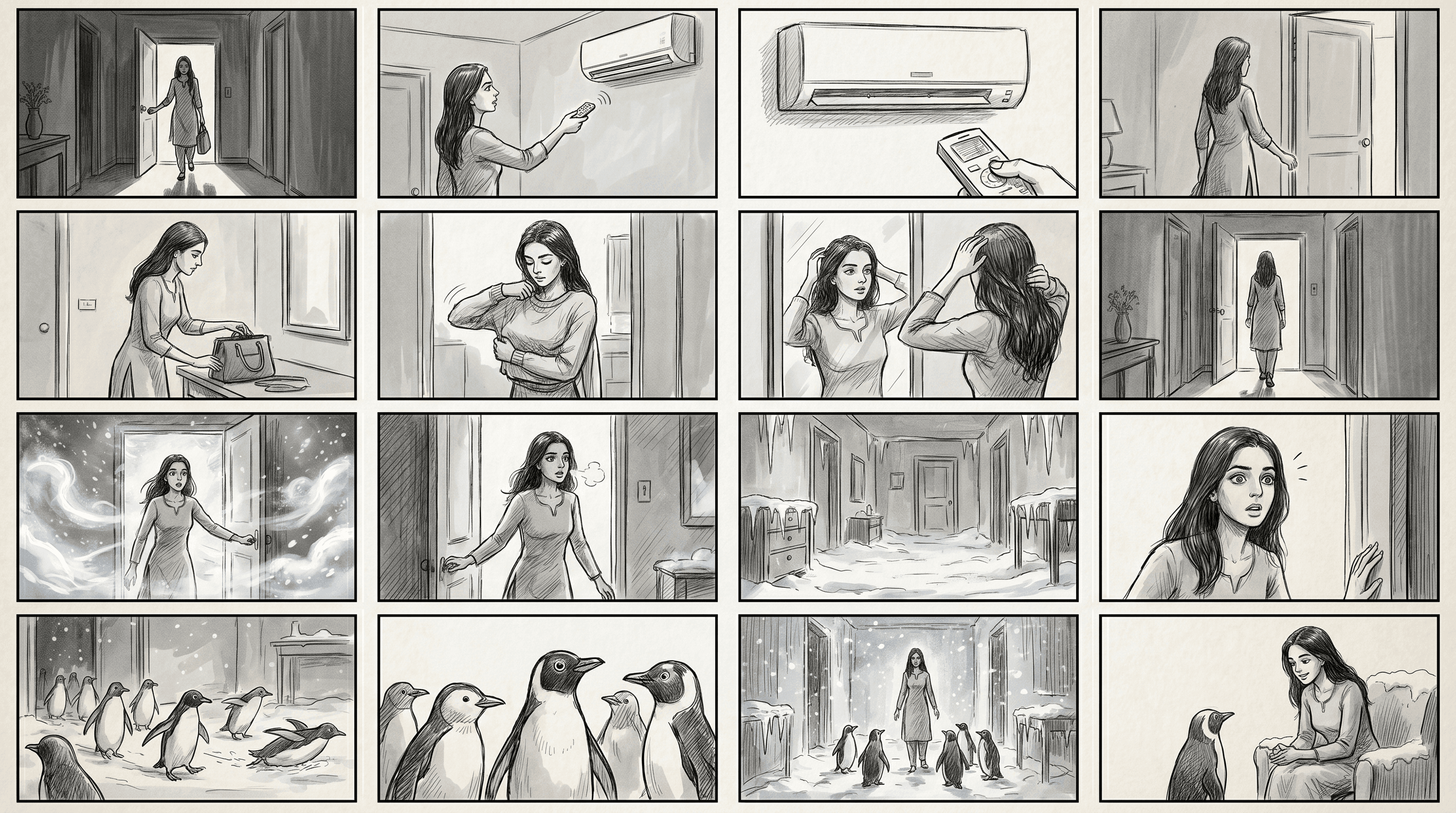
Storyboard first
Frames on paper before frames on screen. Direction lives here, then AI fills the world.
Problems solved
Stop forcing your brand into someone else’s handshake photo. Build the exact scene the brief describes.
B roll that never quite matches. AI motion can fill the gap or replace the dependency entirely.
When schedules collapse, directed AI talent and spaces keep the campaign calendar honest.
Same film, new language treatments and market cuts without rebuilding the whole shoot.
Spaces
Real estate and interior design used to wait on renders, furniture pulls, and site access. AI lets teams show furnished rooms, lighting moods, and lifestyle use before the build is finished.
Campaign stills, packaging mock concepts, OOH key art, and merch visuals can be generated at print aware resolution, then enhanced and prepped so the file survives ink, not just a phone screen.
Finish
Upscale, cleanup, detail recovery, and grade assist turn usable frames into delivery ready assets. Enhancement is not a substitute for a weak idea. It is the last mile when the frame already earns its place.
It is how creators, brands, and audiences meet inside a frame. If you want that frame to feel like YourAILens: directed, consistent, and worth shipping, start with a brief.
Start a conversation